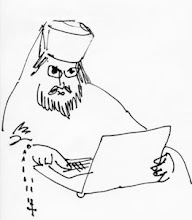
The proprietor of this web log wishes hereby to inform his gentle and long suffering readers that he is in hospital. Upon full convalescence, he will once again take up his keyboard. In the interim, he invites you to peruse the archives or, better yet, to read a book.
Monday, May 12, 2008

Thursday, May 1, 2008
Bright Thursday
 As I've mentioned before, I'm away from my own computer, and thus have been relegated to a French keyboard, which, like all things French, is upside down and backwards. That makes for slow and frustrating typing. My hope had been to dedicate the week to literary descriptions of Pascha, but that is largely out of the question at the moment. For now, however, I can offer an excerpt from Chekhov's Easter Night:
Translation from this edition.One would hqve liked to see this restlessness and sleeplessness in all of nature, beginning with the night's darkness and ending with the slabs; the graveyard crosses, and the trees, under which people bustled about. But nowhere did the excitement and restlessness tell so strongly as in the church. At the entance an irressible struggle went on between eeb and flow. Some went in, others came out and soon went back again. People shuttle from place to place, loiter, and seem to be looking for something. The wave starts at the entrance and passes through the whole church, even disturbing the front rows where the solid and weighty people stand. To concentrate on prqyer is out of the question. There are no prqyers, but there is a sort of massive, chilishly instinctive joy that is only seeking an excuse to burst and pour itself out in some sort of movement, be it only an unabashed swaying and jostling.The same extrordinary mobility strikes one's eyes in the paschal service itself. The royql doors in all the chapels are wide open; dense clouds of inscense smoke float in the air around the big candle stand; everywhere one looks there are lights, brilliance, the sputterding of candles... There are no readings in this service; the busy and joyful singing goes on till the very end; and after every ode of the canon the clergy chqnge vestments and come out to cense the church, and this is repeated every ten minutes.
I had managed to take my place when a wave surged from the front and threw me back. Before me passed a tall, sturdy deacon with a long red candle; behind him the gray-haired archimandrite in a golden mitre hurried with a censer. When they dissqppeared from view, the crowd pushed me back to my former place. But ten minutes had not gone by eore a new wave surged and the deacon appeared again.
Wednesday, April 30, 2008
Bright Wednesday

Christ is Risen!
Here is the Paschal Oration of St Gregory the Theologian, upon which much of the Paschal Canon is based:
Here is the Paschal Oration of St Gregory the Theologian, upon which much of the Paschal Canon is based:
I. It is the Day of the Resurrection, and my Beginning has good auspices. Let us then keep the Festival with splendour, Isaiah 66:5 and let us embrace one another. Let us say Brethren, even to those who hate us; much more to those who have done or suffered anything out of love for us. Let us forgive all offences for the Resurrection's sake: let us give one another pardon, I for the noble tyranny which I have suffered (for I can now call it noble); and you who exercised it, if you had cause to blame my tardiness; for perhaps this tardiness may be more precious in God's sight than the haste of others. For it is a good thing even to hold back from God for a little while, as did the great Moses of old, Exodus 4:10 and Jeremiah Jeremiah 1:6 later on; and then to run readily to Him when He calls, as did Aaron Exodus 4:27 and Isaiah, Isaiah 1:6 so only both be done in a dutiful spirit;— the former because of his own want of strength; the latter because of the Might of Him That calls.II. A Mystery anointed me; I withdrew a little while at a Mystery, as much as was needful to examine myself; now I come in with a Mystery, bringing with me the Day as a good defender of my cowardice and weakness; that He Who today rose again from the dead may renew me also by His Spirit; and, clothing me with the new Man, may give me to His New Creation, to those who are begotten after God, as a good modeller and teacher for Christ, willingly both dying with Him and rising again with Him.
III. Yesterday the Lamb was slain and the door-posts were anointed, and Egypt bewailed her Firstborn, and the Destroyer passed us over, and the Seal was dreadful and reverend, and we were walled in with the Precious Blood. Today we have clean escaped from Egypt and from Pharaoh; and there is none to hinder us from keeping a Feast to the Lord our God— the Feast of our Departure; or from celebrating that Feast, not in the old leaven of malice and wickedness, but in the unleavened bread of sincerity and truth, 1 Corinthians 5:8 carrying with us nothing of ungodly and Egyptian leaven.
IV. Yesterday I was crucified with Him; today I am glorified with Him; yesterday I died with Him; today I am quickened with Him; yesterday I was buried with Him; today I rise with Him. But let us offer to Him Who suffered and rose again for us— you will think perhaps that I am going to say gold, or silver, or woven work or transparent and costly stones, the mere passing material of earth, that remains here below, and is for the most part always possessed by badmen, slaves of the world and of the Prince of the world. Let us offer ourselves, the possession most precious to God, and most fitting; let us give back to the Image what is made after the Image. Let us recognize our Dignity; let us honour our Archetype; let us know the power of the Mystery, and for what Christ died.
V. Let us become like Christ, since Christ became like us. Let us become God's for His sake, since He for ours became Man. He assumed the worse that He might give us the better; He became poor that we through His poverty might be rich; 2 Corinthians 8:9 He took upon Him the form of a servant that we might receive back our liberty; He came down that we might be exalted; He was tempted that we might conquer; He was dishonoured that He might glorify us; He died that He might save us; He ascended that He might draw to Himself us, who were lying low in the Fall of sin. Let us give all, offer all, to Him Who gave Himself a Ransom and a Reconciliation for us. But one can give nothing like oneself, understanding the Mystery, and becoming for His sake all that He became for ours.
VI. As you see, He offers you a Shepherd; for this is what your Good Shepherd, who lays down his life for his sheep, is hoping and praying for, and he asks from you his subjects; and he gives you himself double instead of single, and makes the staff of his old age a staff for yourspirit. And he adds to the inanimate temple a living one; to that exceedingly beautiful and heavenly shrine, this poor and small one, yet to him of great value, and built too with much sweat and many labours. Would that I could say it is worthy of his labours. And he places at your disposal all that belongs to him (O great generosity!— or it would be truer to say, O fatherly love!) his hoar hairs, his youth, the temple, the high priest, the testator, the heir, the discourses which you were longing for; and of these not such as are vain and poured out into the air, and which reach no further than the outward ear; but those which theSpirit writes and engraves on tables of stone, or of flesh, not merely superficially graven, nor easily to be rubbed off, but marked very deep, not with ink, but with grace.
VII. These are the gifts given you by this august Abraham, this honourable and reverend Head, this Patriarch, this Restingplace of all good, this Standard of virtue, this Perfection of the Priesthood, who today is bringing to the Lord his willing Sacrifice, his only Son, him of the promise. Do you on your side offer to God and to us obedience to your Pastors, dwelling in a place of herbage, and being fed by water of refreshment; knowing your Shepherd well, and being known by him; John 10:14 and following when he calls you as a Shepherd frankly through the door; but not following a stranger climbing up into the fold like a robber and a traitor; nor listening to a strange voice when such would take you away by stealth and scatter you from the truth on mountains, Ezekiel 34:6 and in deserts, and pitfalls, and places which the Lord does not visit; and would lead you away from the sound Faith in the Father, the Son, and the Holy Ghost, the One Power and Godhead, Whose Voice my sheep always heard (and may they always hear it), but with deceitful and corrupt words would tear them from their true Shepherd. From which may we all be kept, Shepherd and flock, as from a poisoned and deadly pasture; guiding and being guided far away from it, that we may all be one in Christ Jesus our Lord, now and unto the heavenly rest. To Whom be the glory and the might for ever and ever. Amen.

Monday, April 28, 2008
Bright Monday
 Christ is Risen!
Here is the Bright Monday Sermon of Archbishop Andrei (Rymarenko, 1893-1978) of Rockland, of blessed memory:
Have you noticed, brothers and sisters, how the Holy Church concluded for us the great time which we call the Lenten Triodion? During the entire Lenten Triodion the Holy Church was waking up our heart, was revealing to us all the states of emotion connected with our heart. We had, as it were, to look at what is within us. And when this was manifested in us, then we approached the Cross and the Book of the Gospels and received the promise which the Lord has given to us: "Receive ye the Holy Spirit," said the Lord to His disciples; ‘Whose so ever sins ye remit, they are remitted unto them; and whose so ever sins ye retain, they are retained" (Jn. 20:22-23). And trusting in this daring of the Church, we received, in the Sacrament of Confession, forgiveness.
But after receiving the sanctification of our soul, of our heart, we must continue our way. Here is what the Holy Church gives us: after Golgotha, after the carrying out of the Shroud, after that great moment when we heard, or rather, performed the burial of the Savior, the way on which the Holy Church was leading us seems to change. Up to this moment, we were instructed by readings from Holy Scripture, from the writings of the Holy Fathers. The purpose of all this was to make it possible for us to go more deeply within ourselves.
And now begins, as it were, a different method: the Church gives us symbols. Here, during Holy Night we are given a symbol: in a darkened church we hear the angelic singing, telling us about the Resurrection of Christ. And we begin our way. Before us is elevated the Cross. High, before our eyes — the images of the Saints, the Heavenly Queen, who have become our fellow-travelers into heavenly life. We walk around the church, and this path we are walking on is uneven: there are bumps, stones, and sand. At the same time it is dark. We stumble, we walk unevenly, weaving. We’re on the point of falling, and yet we go on. Before us are signs — the Cross and the holy images. At the same time in church, it is beginning to get light, we see it through the windows. And we know we have to enter this Church. But will we enter? Will we not remain in this darkness forever? Will we not fall? Or will we enter just the same?
And here the Holy Church shows us this way. We are walking around the church. And at the same time, what is going on? The choir is singing. With the angels we are singing and glorifying our Creator. So the Holy Church represents in symbols the way we must go through this year. Maybe the Lord will take us, or maybe once more we will visibly enter the church where the Resurrected Christ will be glorified; and the Grace of Resurrection will enter into communion with our soul.
So yesterday should have gone by under the impression of this symbol. At the end of this day the Church gives us a bright, festive service, where in the Gospel reading, the gift of the Resurrected Lord is given to us. "Peace be unto you" (Lk. 24:36). And we should keep this peace. With this feeling we should have performed today’s first festal Liturgy in daylight. Now it is pointed out to us what we still have to do. And this is what. Back there we were walking in night; we did not see what was around us. But now we are already in the Lord. Peace has rested in our heart. And now we will also walk with the sign of the Cross, with the sign of the Saints; but now we will walk in the light of the sun which, in a spiritual sense, is the result of the Lord’s plan of salvation for us. The Lord has shown us His light and Resurrection. Now we too must walk, but not silently; everywhere we are glorifying the Risen Lord. The Gospel itself orders us: Go and preach to all the nations (Mt. 28:19; Mk. 16:15; Lk. 24:47). Listen, brothers and sisters, to all the nations. About what? — that Christ is risen!
Therefore, do not think that what we are now performing is something of the past. No. It is necessary for our Christian psychology. The purpose is so that yesterday and today will be deeply inscribed on our heart, on our whole life, and will determine all the remaining moments of our life. Because now, not symbolically, but in our experience it will be necessary for us to meet each other, to decide different questions, family and social. At such moments we must remember that, of course, there will be bumps; there will be sand and stones. But all this will not be tragic if we only look upon the Cross of the Lord and the Risen Christ, Who gives us the light of understanding that our life is not here; but that there is eternal life and eternal existence.
May the Lord help us to feel and experience this!
Truly He is Risen!
Sunday, April 27, 2008
CHRIST IS RISEN!
 Christ is risen from the dead,
Trampling down death by death,
And to those in the tombs Bestowing life!
Today is the Feast of Feasts, the Lord's Pascha.
The Paschal Epistle of Archbishop Hilarion of Sydney, Australia, and New Zealand, Deputy of the President of the Russian Orthodox Church Outside Russia can be read here.
At Archimandrite Ephrem's site you will find the full text of the Midnight Office read before the Paschal Procession; and the full text of the Paschal Procession, Matins, Hours, and Liturgy. Moreover, If you're genuinely interested in how the Fathers made use of the Scriptures in composing the liturgical services, then you simply must read this commentary on St John of Damascus' Paschal Canon.
Here follows the stirring Paschal Homily of Our Father Among the Saints, John Chrysostom, which is read towards the end of the Paschal Matins:
The Paschal Epistle of Archbishop Hilarion of Sydney, Australia, and New Zealand, Deputy of the President of the Russian Orthodox Church Outside Russia can be read here.
At Archimandrite Ephrem's site you will find the full text of the Midnight Office read before the Paschal Procession; and the full text of the Paschal Procession, Matins, Hours, and Liturgy. Moreover, If you're genuinely interested in how the Fathers made use of the Scriptures in composing the liturgical services, then you simply must read this commentary on St John of Damascus' Paschal Canon.
Here follows the stirring Paschal Homily of Our Father Among the Saints, John Chrysostom, which is read towards the end of the Paschal Matins:
If any man be devout and loveth God,Let him enjoy this fair and radiant triumphal feast!
If any man be a wise servant,
Let him rejoicing enter into the joy of his Lord.If any have laboured long in fasting,
Let him how receive his recompense.
If any have wrought from the first hour,
Let him today receive his just reward.
If any have come at the third hour,
Let him with thankfulness keep the feast.
If any have arrived at the sixth hour,
Let him have no misgivings;
Because he shall in nowise be deprived therefore.
If any have delayed until the ninth hour,
Let him draw near, fearing nothing.
And if any have tarried even until the eleventh hour,
Let him, also, be not alarmed at his tardiness.
For the Lord, who is jealous of his honour,
Will accept the last even as the first.
He giveth rest unto him who cometh at the eleventh hour,
Even as unto him who hath wrought from the first hour.
And He showeth mercy upon the last,
And careth for the first;
And to the one He giveth,
And upon the other He bestoweth gifts.
And He both accepteth the deeds,
And welcometh the intention,
And honoureth the acts and praises the offering.Wherefore, enter ye all into the joy of your Lord;
Receive your reward,
Both the first, and likewise the second.
You rich and poor together, hold high festival!
You sober and you heedless, honour the day!
Rejoice today, both you who have fasted
And you who have disregarded the fast.
The table is full-laden; feast ye all sumptuously.
The calf is fatted; let no one go hungry away.
Enjoy ye all the feast of faith:
Receive ye all the riches of loving-kindness.Let no one bewail his poverty,
For the universal Kingdom has been revealed.
Let no one weep for his iniquities,
For pardon has shown forth from the grave.
Let no one fear death,
For the Saviour's death has set us free.
He that was held prisoner of it has annihilated it.
By descending into Hell, He made Hell captive.
He embittered it when it tasted of His flesh.
And Isaiah, foretelling this, did cry:
Hell, said he, was embittered
When it encountered Thee in the lower regions.It was embittered, for it was abolished.
It was embittered, for it was mocked.
It was embittered, for it was slain.
It was embittered, for it was overthrown.
It was embittered, for it was fettered in chains.
It took a body, and met God face to face.
It took earth, and encountered Heaven.
It took that which was seen, and fell upon the unseen.O Death, where is thy sting?
O Hell, where is thy victory?
Christ is risen, and thou art overthrown!
Christ is risen, and the demons are fallen!
Christ is risen, and the angels rejoice!
Christ is risen, and life reigns!
Christ is risen, and not one dead remains in the grave.
For Christ, being risen from the dead,
Is become the first-fruits of those who have fallen asleep.To Him be glory and dominion
Unto ages of ages; Amen.
Metropolitan Anthony of Sourozh added the following words after reading this homily on Pascha, 1991:
If I may I wish to add just a few words of my own. Christ is life and the victory of life. In the world in which He came, death was prevalent and seemed to be all-powerful over men; when He came, He defeated death by His resurrection. And nowadays we live in a world which is full of torment, of pain, of fear, of murder, of death, and we may say, “But where is the victory?”.. The victory is in each of us, the victory is in all those of us who believe that death cannot separate us from God, that death is no longer a victory of evil over us, but a triumph of us through our faith, because death is no longer separation. Saint Paul says that for him death is a meeting with Christ; as long as he lives in the flesh he is separated, partly, from God. But with his death he enters in full unity and communion with Him. This is our faith, but there is more to it in a sense, because life is triumphant in our midst. However frightening and dark the world is nowadays, we know that victory has already been won, that God has won and that we who believe in Him partake together with Him in His victory. And therefore, let us bring, to all around us, this message of life and glory!
Christ is risen!
Deacon Matthew Steenberg provides the following valuable links, along with a wealth of other resources for Pascha:
- St Leo the Great of Rome, On the Lord's Resurrection, with a second text by this author
- St Maximus of Turin: Sermon on Pascha and the Good Thief.
St John of Shanghai and San Francisco: Christ is Risen!, Pascha: In the Beginning Was the Word; Pascha!
Metropolitan Philaret of New York: Paschal Epistle, 1982; Paschal Epistle, 1984.
Metropolitan Vitaly of New York: Paschal Epistle, 1997.
- Metropolitan Anthony of Sourozh: Easter Message, 1972; Easter Sermon, 1996;
Friday, April 25, 2008
Fear Not, Little Flock!
Holy Week can be as much a time of darkness and temptation as of light and grace. A whole big bundle of temptations has gotten in the way of blogging this week. God willing, all will go back to normal sometime during Bright Week.
Subscribe to:
Comments (Atom)