Saturday, April 25, 2009

Archbishop Averky on the Incredulity of Thomas

I am posting here my thorough revision and correction of a provisional English translation found online of Archbishop Averky's commentary on John 20:24-31, the Gospel reading for Thomas Sunday:

But Thomas, one of the twelve, called Didymus, was not with them when Jesus came. The other disciples therefore said unto him, We have seen the LORD. But he said unto them, Except I shall see in His hands the print of the nails, and put my finger into the print of the nails, and thrust my hand into His side, I will not believe. And after eight days again His disciples were within, and Thomas with them: then came Jesus, the doors being shut, and stood in the midst, and said, Peace be unto you. Then saith He to Thomas, Reach hither thy finger, and behold My hands; and reach hither thy hand, and thrust it into My side: and be not faithless, but believing. And Thomas answered and said unto him, My LORD and my God. Jesus saith unto him, Thomas, because thou hast seen Me, thou hast believed: blessed are they that have not seen, and yet have believed. And many other signs truly did Jesus in the presence of His disciples, which are not written in this book: But these are written, that ye might believe that Jesus is the Christ, the Son of God; and that believing ye might have life through His name (Jn 20:24-31).
The Evangelist John notes that at the Lord’s first appearance to all His disciples, who were gathered together, the Apostle Thomas (called the Twin, or Didymus in Greek) was absent. As is evident from the Gospel, this Apostle’s character was distinctive in its persistence, bordering on stubbornness, which is characteristic of people of a simple but firmly formed viewpoint. Even when the Lord was going to Judea to raise Lazarus, Thomas expressed his conviction that nothing good would come of that journey: "Let us also go, that we may die with Him" (Jn 11:16). When the Lord said to His disciples in His parting discourse: "And where I go you know, and the way you know," Thomas began to contradict here, too: "Lord, we know not whither Thou goest; and how can we know the way?" (Jn 14:5).

The Teacher’s death at the cross therefore produced an especially painful, dispiriting impression on Thomas: it was as if he had stagnated in the conviction that His loss was irretrievable. His spirits were so low that he was not even with the other disciples on the day of the Resurrection: he had evidently decided that there was no purpose in being together, because everything was finished, everything had fallen apart, and now every disciple had to lead, as before, his own individual, independent life. And then, having met the other disciples, he suddenly heard from them: "We have seen the Lord." In full accord with his character, he sharply and definitively refuses to believe their words. Considering the Resurrection of his Teacher to be impossible, he declares that he would believe this only if he not only saw with his own eyes, but also felt with his own hands the nail wounds on the Lord’s hands and feet, as well as His side that had been pierced by a spear. "And thrust my hand into His side" — from these words of Thomas it is evident that the wound inflicted by a soldier on the Lord was very deep.

Eight days after the Lord’s first appearance to the ten Apostles, the Lord once again appeared, with "the doors being shut," evidently in the same house. This time Thomas was with them. Perhaps, under the influence of communication with the other disciples, his obdurate disbelief had begun to leave him, and his soul had slowly become again capable of faith. The Lord appeared to inflame this faith in him. Appearing, as in the first case, perfectly unexpectedly among His disciples and having granted them peace, the Lord turned to Thomas: "Reach hither thy finger, and behold My hands …" The Lord responds to Thomas’s doubts with the very words with which he had conditioned his belief in His Resurrection. It is clear that the Lord’s knowledge of his doubts alone should have amazed Thomas. The Lord added to this: "be not faithless, but believing," that is: you are in a decisive position: there are now only two paths before you — full faith or decisive spiritual hard-heartedness. Although in the Gospel it does not say whether Thomas in fact touched the Lord’s wounds, one can assume that he did. In any case, faith was greatly inflamed within him, and he exclaimed: "My LORD and my God!" By these words Thomas confessed not only his belief in Christ’s Resurrection, but also in His Divinity.

Nonetheless, this faith was based on sensual attestation, and therefore the Lord, for the edification of Thomas, the other Apostles, and all people of all ages, reveals the loftiest path towards faith, praising those that have attained faith not in the sensual way that Thomas had: "Blessed are they that have not seen, and yet have believed." The Lord had previously more than once given priority to faith that is based not on miracles, but on words. The spread of the faith of Christ throughout the world would have been impossible if everyone had demanded the same confirmation of his belief as had Thomas had, or continuous miracles in general. Therefore the Lord praises those who attain faith alone through trust in the testimony by word, through trust in the teaching of Christ. This is the best path to faith.

With this narrative Saint John concludes his Gospel. Chapter twenty-one, which follows, was written by him later, after a certain period of time, as is thought, because of the rumor that he was appointed to live until the Second Coming of Christ. For the moment, Saint John concludes his narrative with the testimony that "many other signs truly did Jesus in the presence of His disciples, which are not written in this book" – although Saint John had set himself the goal of supplementing the narratives of the first three Evangelists, he himself recorded not everything, far from it. At the same time, however, it is evident that he feels that what has been written is sufficient "that ye might believe that Jesus is the Christ, the Son of God; and that believing ye might have life through His name" — and that little which has been written is sufficient for the confirmation of faith in Christ’s Divinity and for salvation through this faith.
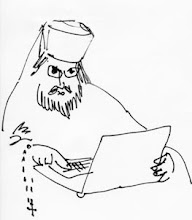
Photograph: Vladyka Laurus and Vladyka Averky.

Metropolitan Anthony on Thomas Sunday

Here follows my translation of a brief word given by Metropolitan Anthony (Khrapotvitsky) of Kiev and Galicia (+1936) on Thomas Sunday:
One can say that everyone rejoices when they hear the troparion of the Resurrection. But they sometimes grow bored when it is sung often. This hymn, however, should be endlessly joyful to people: its continual repetition about the victory over death and the devil should be an infinite source of consolation. Therefore if this joy soon passes, it passes because one’s faith is not so living and strong. People find it difficult to believe because their souls do not especially love this victory.

They say: Thomas, who had been previously ready to die for Christ, also did not believe.

No, Thomas asked for assurances not because he did not believe, but because he desired an untroubled faith, for he longed for the resurrection and understood its significance.

Before their entry into Jerusalem, having learned that there would not be any external success but, to the contrary, that the Savior awaited suffering, the disciples thought that the same death awaited them as a reward for following Him. They were overcome by horror and fear, and then Thomas said: Let us go that we might die with Him [Jn 11:16]. Thomas had a loyal heart. How many of them were troubled when they learned that there was not, and would not be, any external success! When He was to them a great miracle worker, healing them and giving them bread, they believed; but when they learned that He was ready to accept and bear the great deed [podvig] of patience and suffering for the sake of their spiritual benefit – then they all ran away, their faith weakened and, if their conscience rebuked them, they easily found an excuse in themselves: we trusted that it had been He [Lk 24:21].

People say: if we had seen Him we would not have denied Him. This is not true: the majority of those who denied Him had seen Him, and they denied Him because they did not love spiritual values, and the victory over the devil spoke but little to their hearts; they desired external success.

Cases of full denial are not many. Normally a remnant of faith remains, and this half-acknowledgment and half-faith is perhaps even worse, and such half-believers are in the majority. If they were to be excluded from so-called believing society we would see that there are but few true worshippers. Church and cross, unity in Christ, unity in the name of the feat [podvig] of love – there is the outline of our relationship towards the Lord. But half-believers do not strive to understand either one or the other – unity or Christ’s love – in the way that Christians understand it.

Half-faith has many degrees, but one thing inevitably follows from all half-belief. Those who deny know both what they have denied and to what to return. But the half-believer does not have any such clarity and grows accustomed to a life guided by sophistries, half-truth, and hints at some sort of supposed truth.
Photograph: Metropolitan Anthony on Mt Athos, 1920.

Thomas Sunday

Tomorrow is the Sunday of Antipascha, also known as Thomas Sunday, on which we commemorate the Holy Apostle Thomas' touching of the Master's side. S. V. Bulgakov writes:
This Sunday commemorates the appearance of the Lord to the Apostles after His resurrection and the touching of His wounds by the Apostle Thomas. The circumstances of these events are sung in all the stikhera and troparia of the canon on Apostle Thomas Sunday and in the stikhera of the other days of this week. The appearance of the risen Lord to the Apostle Thomas and all the eleven is selected for the first Sunday after the Paschal Sunday because the circumstances of this appearance serve as the indisputable proof of the resurrection of the Lord from the tomb, "as from the chamber, with His immaculate flesh". It assures not only believers and the amazed of the joy of all the followers of the Lord, but even the infidel pagans and the enemies of Christ the Savior - the Judeans. It assures that by the power of His Divinity Jesus Christ is risen again from the tomb, that after the resurrection He did not have an imaginary or illusory flesh in which form the bodiless spirits or inhabitants of heaven are vested when they sometimes appear to us or to the holy brethren, but the real immaculate flesh which He has assumed from the womb of the All-holy Theotokos, with which He was nailed to the cross and on which there remained wounds even after the resurrection.

Friday, April 24, 2009

The Spiritual Testament of Metropolitan Philaret

CHRIST IS RISEN!

His Eminence, Metropolitan Philaret of Eastern America and New York, was the third First Hierarch of the Russian Orthodox Church Abroad. He was born Georgii Nikolaevich Voznesnsky on March 22, 1903, in Kursk. Upon seizure of power by the Bolsheviks and the onset of the civil war, the Voznesensky family fled to Harbin, Manchuria. His father, a priest, took monastic vows with the name Dimitry after the repose of his wife and was elected Archbishop of Hailar. The future Metropolitan graduated from the Russian-Chinese Polytechnic Institute in 1927 with a degree in electrical engineering. He then began classes in theology at the Saint Vladimir Institute, from which he graduated in 1931. He was tonsured with the name Philaret and ordained in December of 1931. In 1937 he was elevated to the rank of archimandrite and served in various capacities in the Diocese of Harbin. During this time, when Harbin was under Soviet occupation, he refused to take a Soviet passport. In 1962, at the onset of Chairman Mao’s “Cultural Revolution,” Archimandrite Philaret was permitted to leave Harbin. He traveled at first to the then British Crown Colony of Hong Kong and, after a short time, to Australia. On May 26, 1963, he was consecrated Bishop of Brisbane and vicar to Archbishop Sava of Sydney and Australia. In the following year, 1964, Bishop Philaret, although the most junior of the bishops, was unanimously elected the new First Hierarch. In 1974 Metropolitan Philaret presided over the Third All-Diaspora Council, held in Jordanville, NY. Metropolitan Philaret became an outspoken opponent of ecumenism, issuing a series of three “Sorrowful Epistles” between 1969 and 1975. He reposed on November 21, 1985, and was buried at Holy Trinity Monastery in Jordanville, NY. In 1998 his relics were discovered to be wholly incorrupt.

The following is my translation of his spiritual testament, found in his typewriter after his blessed repose:
Hold that fast which thou hast (Rev 3:11).
These words, taken from the sacred Book of the Apocalypse, have a particular significance in our time, in our greatly sorrowful, evil, temptation-filled days. They remind us of that priceless spiritual wealth that we possess, as children of the Orthodox Church.

Yes, we are rich. This spiritual wealth is that which the Holy Church possesses, and it is offered to all her faithful children. The teaching of the Faith, of our marvelous, salvific Orthodox Faith; the countless living examples of the lives of people who have lived according to the Faith, according to those lofty principles and rules that the Church offers us. Those who have attained that spiritual purity and exaltedness that is called holiness; the beauty and majesty of our Orthodox Divine services and a living participation in them through faith and prayer; the plenitude of the grace-filled spiritual life that is open to each and every one, and, crowning it all, the unity of the children of the Church in that love of which the Savior said: By this shall all men know that ye are My disciples, if ye have love one to another [Jn 13-35].

Bright Friday: The Life-Giving Spring

CHRIST IS RISEN!

Today, Bright Friday, we celebrate the consecration of the Church of the Mother of God of the Life-Giving Spring and the miracles wrought therein. Here is how S. V. Bulgakov describes today's commemoration:
On this day in Matins the stikhera of the full canon in honor the Mother of God composed by Nicephorus Callistus (14 century) in memory of the rededication of the Temple of the Theotokos, named the Life-bearing Spring, are joined to the festal stikhera and troparia of the canon.

According to the Synaxarion, the Life-bearing Spring (in the vicinity of Constantinople) was revealed to the Greek Emperor Leo the First when he was yet a simple warrior (in 450). Once as he was walking about the grove surrounding this spring, Leo met a blind man, exhausted from thirst and weariness, wandering about. Wishing to help the blind man, Leo went to find water and after a long vain search he heard a voice which pointed out the spring to him. With the water of this spring, Leo quenched the thirst and opened the sight to the blind man. Leo, after rising to the Greek throne, constructed a temple on this place in the name of All Holy Theotokos, calling his temple the Life-bearing or Life-receiving Spring. Many of the infirm received wonderful healing from this Life-giving Spring, which the Synaxarion commemorates on the present day.

In the hymns for this day the Life-bearing Spring is glorified as an ever flowing source of grace diversely manifested to the believer after powerful petition to All Holy Theotokos. Remembering in its hymns the wonderful signs of the grace of God revealed during the passage of time at the Life-bearing Spring, the Holy Church at the same time calls for its children to worthily magnify and glorify the Virgin Theotokos.
The relevant Wikipedia article relates the following sad account of the subsequent history of this church:
After he became emperor, Leo built a church dedicated to the Theotokos of the Life-giving Spring over the site where the spring was located.[2] After the Fall of Constantinople in 1453, the church was torn down by the Turks, and the stones used to build a mosque of Sultan Bayezid. Only a small chapel remained at the site of the church. Twenty-five steps led down to the site of the spring surrounded by railing. As a result of the Greek Revolution of 1821, even this little chapel was destroyed and the spring was left buried under the rubble.

In 1833 the reforming Ottoman Sultan Mahmud II gave permission for the Christians to rebuild the church. When the foundations of the original church were discovered during the course of construction, the Sultan issued a second firman permitting not only the reconstruction of the small chapel, but of a large church according to the original dimensions. Construction was completed on December 30, 1834, and the Ecumenical Patriarch, Constantine II consecrated the church on February 2, 1835.

On September 6, 1955, the church was destroyed again by Moslems during a riot. Another small chapel has been rebuilt on the site, but the church has not yet been restored to its former size. The spring still flows to this day and is considered by the faithful to have wonderworking properties.
For more on today's commemoration, see here and here. See also the service in Greek and Slavonic. Of related interest is Fr Ephrem's short paper explaining why the Greek word zoopoios should be translated as "life-giving" rather than "life-creating."

Please note that I am having trouble with my internet connection. This may result in an interruption in posting until the problem is resolved.

Thursday, April 23, 2009

Bright Thursday: Rejoice in the Lord Always

CHRIST IS RISEN!

Here is my translation of a brief Paschal homily given by the much-missed Bishop Mitrophan of Boston (+2002):
Christ is Risen!

What a heavenly, luminous joy does the sound of these two words convey to every Christian soul, immortal by nature. This eternal, inexhaustible, universal joy began when the Risen Lord appeared to the Myrrbearers on the first day with the word: “Rejoice!” They ran to the Apostles with the joyful tiding: “Christ is Risen! Truly He is Risen!” and the Conqueror of death revealed Himself to the Apostle Peter. The tiding of Christ’s Resurrection has become the foundation of faith and the inexhaustible source of joy ever since, not only for the Apostles, but for every faithful person. For the sake of Christ’s Resurrection have not only the Apostles, but all the faithful of all times, and in our own days, forgotten and do forget their personal lives, everything earthly, and followed Him to any suffering, even to death on the cross. This is because the Resurrection of Christ is an Historical Fact.

Pascha! This Feast of feasts calls us from slavery to sin to freedom and eternal life! This is a joyful Feast, invigorating our soul, calling all to Divine joy and to rejoicing. Rejoice in the Lord always: and again I say, Rejoice, the Apostle cries out to us. The essence of our Paschal joy is that we “celebrate the death of death, the beginning of another life eternal.”

We are all, dear brothers and sisters, Christians. Christianity is a religion of joy. Pascha is not a remembrance, it is not a dream. Pascha is reality! It was always Pascha for St Seraphim of Sarov. “My joy, Christ is Risen!” – this is how the saint greeted everyone who approached him, both in spring and summer, both in fall and winter. Why? Because he lived in Paschal joy, he firmly believed in God’s presence in the world and in the reality of the other world. Other saints, too, never tired of repeating the words of the Apostle – “rejoice always.” When they were asked how this joy could be acquired, they answered: this joy comes from a pure heart and unceasing prayer.

In the weeks preparatory to Holy Pascha, the weeks of the Great Fast, the Lord, overlooking our shortcomings in His love and mercy, called us to Himself. We, “with fear of God and faith drawing near,” “tasted the source of immortality,” and sang with great joy on the Paschal night: “a Pascha of the faithful, a Pascha that hath opened the gates of Paradise to us.” The gates are open. May every one of us enter. In order to enter, everyone needs to continue to work on themselves, for Eternal Joy, the plentitude of which is expressed in Christ’s Resurrection, is accessible to us as a result of our confirmation in Christ. How? Through unceasing spiritual vigilance and the conquering of fleshly wisdom. Amen.

Christ is Risen!

Wednesday, April 22, 2009

Earth Day

CHRIST IS RISEN!

Today is Earth Day, at least in the Northern Hemisphere. While I hesitate to appear churlish or to hinder anyone from reflecting on our very real duties towards creation, I would submit that Orthodox Christians have very good reason to be wary of what Earth Day represents.

It should come as no surprise that Earth Day is a product of the 1960s, having been formally established in 1970 largely through the efforts of Gaylord Nelson, Democrat Senator from Wisconsin. The ideological context in which he conceived of Earth Day is chilling: he was deeply influenced by the movement towards zero population growth, which, needless to say, placed so-called "reproductive rights" at the center of its agenda. (The organization that called itself "Zero Population Growth," founded in 1968, has since changed its name to the less threatening sounding "Population Connection" – which sounds to me rather like a PBS show for children.) It was this same Senator Nelson that called for hearings on the safety of combined oral contraceptive pills, hearings that have gone down into history as the Nelson Pill Hearings. (As an ironic side note, Senator Nelson and others were also deeply concerned about the effects of global cooling.) The word eugenics springs involuntarily to mind. How evil the irony that the promotion of Earth's health was thought to depend upon putting an end to the growth of humanity.

Then there is the inevitable connection between modern environmentalism and neo-paganism. The Earth becomes, not a gift of God's creation, but a sacred, self-subsisting, and life-giving entity in and of itself. Western civilization in general, and Christianity in particular, are more often than not assigned blame for environmental pollution. Environmentalism becomes a substitute religion (and a highly dogmatic one at that), with its own feast days. Here is how Margaret Mead – that influential but utterly fraudulent anthropologist – spoke of Earth Day in 1978 (emphasis mine):
EARTH DAY is the first holy day which transcends all national borders, yet preserves all geographical integrities, spans mountains and oceans and time belts, and yet brings people all over the world into one resonating accord, is devoted to the preservation of the harmony in nature and yet draws upon the triumphs of technology, the measurement of time, and instantaneous communication through space.

EARTH DAY draws on astronomical phenomena in a new way – which is also the most ancient way – using the vernal Equinox, the time when the Sun crosses the equator making night and day of equal length in all parts of the Earth. To this point in the annual calendar, EARTH DAY attaches no local or divisive set of symbols, no statement of the truth or superiority of one way of life over another. But the selection of the March Equinox makes planetary observance of a shared event possible, and a flag which shows the Earth as seen from space appropriate.
This is a very good reminder, incidentally, that paganism and religious and moral relativism are close cousins. Although, really, her words are disingenuous: environmentalism really is all about "the superiority of one way of life over another." It's also worth noting that – coincidence or no coincidence – Earth Day is marked annually on Lenin's birthday. I hope these few points should be sufficient to give pause for thought.

None of which is to deny that we really have done horrible things to the environment or to imply that we are not called to stewardship of creation. It strikes me as tragic that the environmental movement is almost wholly a creature of the political Left. It's quite understandable – but, I think, deeply misguided – that many conservatives would adopt a largely reactionary stance to environmental issues, denying the reality of the environmental travesty that surrounds us while applauding all the sprawl that comes with the unrestrained free market.

We Orthodox do, in fact, have an alternative to Earth Day. In 1989 the Day of Prayer for Creation was established by the Ecumenical Patriarchate and accepted by other local Orthodox Churches. Notice the words prayer and creation. It is celebrated on September 1, the first day of the liturgical year. In fact, Monk Gerasimos (+1991) of the Skete of St Anne on Mt Athos, official hymnographer of the Great Church, composed an Office for the Preservation of Creation (the Vespers from which can be read in English, translated by Fr Ephrem (Lash), here.) There is very much that could be said here, but I think it sufficient to cite one small passage from the words of the Elder Paisios of Mt Athos:
This grass is an icon; this stone is an icon; and I can kiss it, venerate it, because it is filled with God's grace.

The world is not for us to take things from, but a place where we cast off our passions and desires.
There is no doubt that we need to assist in reversing the profound violence we have done to God's creation. But our premises should be above all theological or, more specifically, Eucharistic – and not neo-pagan, relativistic, or anti-Christian. The question of how exactly this would look in terms of policy is one that I leave to others. For more, see especially Dr Elizabeth Theokritoff, "The Orthodox Church and the Environmental Movement," and Metropolitan Kallistos' essay "Through Creation to the Creator," and a large collection of similar resources here.

UPDATE: See the excellent follow-up posts at Orrologion and Logismoi.