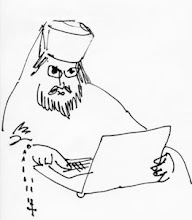
Why do people leave one place and move to another? Mainly because they hope to be happier in the other place. And, from the point of view of earthly life and contentment, places can indeed be different, better or worse. He who has no hope of a better life after death seeks a better sensual pasture in this life. But if you look into the hearts of the people who have settled themselves in the so-called 'best places' on this terrestrial sphere, you will perceive discontent, sorrow and despair. They have not found what they were looking for. They fed to satiation everywhere and, in the end, still hungry, looked into the eyes of death.Photos: Karoulia on Mount Athos (if you look very closely you can see the cells of hermit monks); the suburbs.
But look at the Christian saints! They chose the least verdant places, 'dry, impassable and waterless,' lonely and terrible places that attracted the least attention and that no-one would wish to possess. They regarded all places on earth as equally without value, but chose these places solely in order to draw nearer in mind and spirit to their eternal home. And if one were to look into their hearts, one would perceive joy and contentment.
Friday, February 29, 2008
The Desert and the Suburbs
Thursday, February 28, 2008
Postcards from Greece
Here's a series of podcasts by Fr Peter Alban Heers that's very much worth the listen:
In this podcast from his mountaintop village, Petrokerasa, Greece, Fr. Peter shares with us his ten years of experience of living the Faith and serving the Church in Greece, and in particular the ancient Church of the Thessalonians. It was to the Church of Thessalonica that the Apostle Paul preached the Faith 2,000 years ago and the wonderworker and hierarch Holy Gregory Palamas expounded his divine theology more than 500 years ago. On visits to parishes and monasteries, and in interviews with clergy and laymen, Fr. Peter, as an American convert, introduces us to the ancient practice of the Church in Greece in terms and ways we can readily understand and apply to our contemporary way of life.Fr. Peter Alban Heers is the founder and first to serve as editor of Divine Ascent, A Journal of Orthodox Faith, and the founder and current head of Uncut Mountain Press. He is a Ph.D. candidate at the Theological School of the University of Thessalonica, where he has also completed his undergraduate studies and Masters degree in Dogmatic Theology. He is the rector of the parish of the Holy Prophet Elias in Petrokerasa, a small village in the mountains outside of Thessalonica, Greece.
Visit our Schedules page to see when this podcast will be broadcast on Ancient Faith Talk.
See more here.
Is Kosovo Independence a Good Thing?
If your answer is yes, then watch this video and get back to me.
The Prodigal Culture
The prodigal son (as we heard in last Sunday's Gospel reading) left his father's house, blew his inheritance on loose living, and ended up working in a pig sty. As we know, however, he came to his senses, returned home, and was forgiven by his loving father.But what if he hadn't repented? What if he had been quite satisfied with the work, quite happy to be given some husks now and then, and quite willing to stay put? He could have married one of his boss's daughters, settled down, and worked 9 to 5 in the pigpen.
Now say that they had kids, who in turn had more kids, who in turn eventually created an entire piggish civilization. They subdued nature around them to build ever bigger and stinkier pig cities, created pig-sty-centered arts and literature, and produced scholars who could document (and even eventually deconstruct) the evolution of their swinish culture.
If someone were to remind such people that there is a Father's House to which one could return, be forgiven, and lead a life that transcended the here-and-now piggishness of their life of porker materialism, he'd be mocked as out of touch with reality. The meaning of life, after all, is to be found in one's service to the greater needs of the pigpen, and after death one's existence will live on only in the memory of one's service to the noble ideals of hog-keeping.
The pigpen is real, after all, and has evolved from primordial mud: this can be demonstrated scientifically. Early pig-man held some naive notions of a Father's House, but this is no longer a helpful hypothesis; everyone knows that it was a psychological projection made by pre-scientific peoples. Such mythology laughably attempted to explain things without the means of modern pig science; now that we can make use of the scientific method, such mythologies are to abandoned by any civilized keeper of porkers. Indeed, those who persist in maintaining such mythologies are responsible for all continuing misfortunes, and should lose the right to educate their young in such swineless prejudice. We know, after all, that we and the pigs share common DNA, and any notion we might have of some imaginary Father is wish-fulfillment at best, and deeply subversive to the future of pig farming at worst. Let us imagine a world in which everyone's consciousness can be sufficiently raised to make them all truly piggish!
This little flight of fancy, needless to say, bears no resemblance to actual fact, and should be taken as purely fictional. No pigs were harmed in its creation.
Allegorizing the Odyssey
The Fathers did not limit their use of allegory to interpreting the Holy Scriptures. Here is an excerpt from Book XII of Homer's Odyssey, that great textbook of the ancient world, in which Odysseus instructs his sailors to tie him upright against the mast of his ship in order to sail safely by the Muses:"Friends, since it is not right for one or two of us only to know the divinizations that Circe, bright among goddesses, gave me, so I will tell you, and knowing all we may either die, or turn aside from death and escape destruction. First of all she tells us to keep away from the magical Sirens and their singing and their flowery meadow, but only I, she said, was to listen to them, but you must tie me hard in hurtful bonds, to hold me fast in position upright against the mast, with the ropes' ends fastened around it; but if I suplicate you and implore you to set me free, then you must tie me fast with even more lashings." (XII: 154-164)
Sail past their music and leave it behind you, for it will bring about your death. But if you will, you can be the victor over the powers of destruction. The Logos of God will be your pilot, and the Holy Spirit [pneuma, wind] will bring you to anchor in the harbor of heaven.
Wednesday, February 27, 2008
William F. Buckley, Jr. (1925-2008)
William F. Buckley, Jr., the father of the modern conservative movement, passed away overnight in his home in Stamford, Connecticut.Well, yes, I do. I think that's absolutely central to Christianity. St. Paul thought so, and so does everybody. If Christ has not risen, then everything is in vain. But the circumstances of His resurrection were quite widely reported, and we know that His apostles devoted their entire lives in ways that would not be thinkable, except on the absolute certainty that this had happened. So yes, I think it is central, and I devote a certain amount of time to that. It is, I think you're correct in suggesting that it is often thought of as simply a myth, sort of a happy thought. I don't think it's happy thought. If it were, as Russell Kirk--I quote here--then Christianity would be something--nothing more than simply conjurings of social observations. It's the startling fact, Christ rose.(Hat tip: Blogging Religiously)
And here are Mr Buckley's thoughts on traditional liturgical language, written in his unmistakable prose and with all his usual wit:
(Hat tip: Western Orthodoxy)This morning, the Church of England has issued its re-wording of the Lord's Prayer. Now, the head of the Church of England, at least titularly, is the Queen of England. She continues to be addressed with all the euphuistic pomposity of Plantagenet prose, but now they are modernizing the form of address appropriate to God. One continues to refer to the Queen as Your Majesty, and as "Ma'am," but for God, "Thee" and "Thou" are—out. The Lord's head has been placed on the Jacobinical block. He is not quite yet addressed as Comrade, or even Big Brother: but He is definitely made to feel at home in the modern world.
It now goes not, "Our Father, Who art in Heaven, hallowed be Thy name"—but "Our Father in Heaven, hallowed be Your Name." Granted, they have left the capital letter in "Your," which must have been done after grave debate in the relevant councils. But clearly it was felt that "Thy" was simply—too much. Who does He think He is? The Queen of England?
It goes on, "Your will be done on earth as in Heaven." One wonders what has been gained by that formulation over the traditional formulation, which read, "Thy will be done on earth as it is in Heaven." There is transparent here something on the order of a Parkinsonian imperative: A venerable passage will be reworded by a rewording commission insofar as a commission to reword possesses the authority to do so.
...[S]ome would go so far as to say that it is most unlikely that [the Lord's will] is being done by the Royal Commission on the Vulgarization of the Book of Common Prayer when they take such a sentence as "Thy will be done on earth as it is in Heaven" back from the alchemists who worked for the Lord and for King James, and beat it into the leaden substitute which they have now promulgated.
One wishes that were all, but there is no sin of omission for which we might be grateful. "Lead us not into temptation, but deliver us from evil" has been changed to, "Do not bring us to the time of trial, but deliver us from evil." Why? For the sake of clarity? (That is the usual answer.) I know, because every sense in my body informs me, and every misinclination of my mind, what is temptation, from which we seek deliverance. But "the time of trial"? That sounds like the Supreme Court is in session...
Perhaps it was ordained that the Anglicans, like their brothers the Catholics, should suffer. It is a time for weeping, and a time for rage. Do not go gently into the night. Rage, rage against the dying of the light. That would be the advice of this outsider to my brothers in the Anglican Church. They must rage against those who bring upon Christianity not only indifference, but contempt.
May his memory be eternal!
Complicating Matters
Russell Jacoby writes:
"I hope today to complicate our notion of cahiers — grievances — and the role they played in the States-General of 1789." The professors and graduate students at the symposium nod appreciatively. They have heard or read similar justifications untold times before. The author explains that he or she will "complicate" our understanding of some event or phenomenon. "In this article," writes an ethnic-studies professor, "I seek to complicate scholars' understanding of the 'modular' state by examining four forms of indigenous political space." Everyone seems pleased by this approach. Why? The world is complicated, but how did "complication" turn from an undeniable reality to a desirable goal? Shouldn't scholarship seek to clarify, illuminate, or — egad! — simplify, not complicate? How did the act of complicating become a virtue?The refashioning of "complicate" derives from many sources. One recipe calls for adding a half cup of poststructuralism to a pound of multiculturalism. Mix thoroughly. Bake. Season with Freudian, Hegelian, and post-Marxist thought. Serve at room temperature. The invitees will savor the meal and will begin to chat in a new academic tongue. They will prize efforts not only to complicate but also to "problematize," "contextualize," "relativize," "particularize," and "complexify." They will denounce anything that appears "binary." They will see "multiplicities" everywhere. They will add "s" to everything: trope, regime, truth. They will sprinkle their conversations with words like "pluralistic," "heterogenous," "elastic," and "hybridities." A call for "coherence" will arrest the discussion. Isn't that "reductionist"?
Unfortunately, such a recipe is often used to cook theology in the academic kitchen, as anyone who has taken graduate theological courses can attest. It's even affected my own field of interest, Patristics, which has now been folded into Late Antiquity, whisked free of its theological content, baked in a shell of social theory, and served neither cold nor hot. The result is a goopy and inedible mess that's lost all the salt of the Gospel, but is generously frosted with Foucault's excrement.
Tuesday, February 26, 2008
Holiness or Democracy?
Kosovo is the heart of Serbia; Orthodoxy is the heart of Kosovo; and holiness is the heart of Orthodoxy. The recognition of the illegal declaration of Kosovo as a Muslim-dominated state is not only an act of geo-political suicide, but a further dismantling of what little remains of the Christian civilization of Europe. Not only is Christianity quickly disappearing from Europe, but even its silent monuments are being destroyed. To remind ourselves of why and how Christianity is at the heart of our civilization, we need only to look to the memory of the saints. Today the Orthodox Church celebrates the memory of St Stevan Nemanja (Simeon in monasticism), the Myrrhgusher and Prince of Serbia. Bishop Nikolai (Velimirovic), himself a twentieth-century saint of the Serbian Orthodox Church, writes the following brief life of St Stevan:Stevan Nemanja, the great ruler of the Serbian people, unifier of the Serbian lands, creator of an independent Serbian government, defender of Orthodoxy, driver-out of heresy, was first baptised in the Latin Church, but later became a member of the Orthodox Church. In its organisation, it was at first dependent on Greece, but later shook off this dependence and became completely autonomous. When he had strengthened the state and the Orthodox Church within the state he then, following the example of his son Sava, received the monastic habit at the monastery of Studenica in 1195, being given the name Simeon. His wife Anna also received the monastic habit and the name Anastasia, and retired to a women's monastery. After two years' monasticism at Studenica, Simeon went to the Holy Mountain. There he stayed at first in the monastery of Vatopedi, together with Sava. Father and son spent days and nights in prayer. They built there six chapels: to the Saviour, the Unmercenaries, St George, St Theodore, the Forerunner and St Nicolas. They bought the ruins of Hilandar and built a beautiful monastery, in which Simeon lived only eight months before his death. When he was at his last breath, Sava, according to his wish, placed him on a simple rush mat. With his eyes fixed on the icon of the Mother of God with the Saviour, the blessed elder pronounced these words: 'Let everything that hath breath praise the Lord.' And he went to the Lord, on February 13th, 1200.Bishop Nikolai then adds this reflection:
The great Stevan Nemanja, whose authoritative word was unreservedly heeded by all, at whom peoples and kings trembled, became a monk and served the monks of the Holy Mountain as a model example of meekness, humility, goodness and prayer. And his death was the death of a truly godly man and spiritual guide. He took to his bed on February 7th, called St Sava to him, placed his hands on him and blessed him, saying: 'My beloved child, light of my eyes, comfort and guardian of my old age, the time for us to part has come; the Lord is letting me go forth in peace. But do not grieve, my child, for our parting; this is common to all. Here we part; but we shall meet again hereafter, where there is no more parting.' On February 12th St Simeon told Sava to dress him in his burial habit, spread rushes for him on the ground, put a stone for his head and thus lay him there. Then he called together all the monks and asked their forgiveness. At dawn on the 13th, while the monks were singing the morning office in the church, their voices reached the dying man's cell, St Simeon's face lit up once more and he gave his soul to God.Is this the sort of figure whose memory we wish to erase and whose churches we wish to destroy? Are the modern ideals of tolerance and democracy more important than preserving and defending monuments to such holiness? What sort of man does our society today wish to create? One need only turn to Socrates' description of the "democratic man" in The Republic (VIII: 561) for an answer:
Yes, I said, he lives from day to day indulging the appetite of the hour; and sometimes he is lapped in drink and strains of the flute; then he becomes a water-drinker, and tries to get thin; then he takes a turn at gymnastics; sometimes idling and neglecting everything, then once more living the life of a philosopher; often he is busy with politics, and starts to his feet and says and does whatever comes into his head; and, if he is emulous of any one who is a warrior, off he is in that direction, or of men of business, once more in that. His life has neither law nor order; and this distracted existence he terms joy and bliss and freedom; and so he goes on.Whom is it that we should aspire to emulate: the man of holiness or the man of democracy? Which civilization should we defend: one that, at the very least, defends the Christian past; or one which reifies – and even deifies – the noble lie of democracy, even when it seeks to destroy the last remaining monuments of Christendom?
The above fresco depicts St Stevan as a monk.
Monday, February 25, 2008
Dr Trifkovic's Prognosis
From a column by Dr Srdja Trifkovic, probably the best political analyst of the Balkans writing today:It is difficult to make forecasts about Belgrade’s forthcoming responses—not least because they are treated as closely guarded secrets—but the following sequence of events is, in my opinion, at least less unlikely than any other:
Please read the full article here.
- The inherent schizophrenia splitting the ruling coalition in Serbia will be subjected to intolerable strains in the next few weeks, primarily over the issue of how to respond to the forthcoming acts of recognition by the United States and leading EU countries. Kostunica favors weighty moves, while Tadic and his ministers will insist on empty gestures—e.g. withdrawing ambassadors from Western capitals—that fall far short of breaking diplomatic relations.
- The resulting election will mark the long-overdue demise of the DS, with its worn out Euro-rhetoric that has yielded zero dividends over the past eight years. The winners will be the Radicals (SRS) and Kostunica’s Democratic Party of Serbia (DSS). They will either form a long-overdue coalition, or else Kostunica will try to form a national unity government in which the Radicals will be represented (and from which Tadic and his DS will stay away because their “friends” in Brussels and Washington would never allow them to be in the same room with Nikolic).
- The entity proclaimed in Pristina will be recognized by the United States, by most of the Islamic world—which will find itself aligned, yet again, with America in promoting Islam and fighting Christianity in the Balkans—and by about a half of the European Union’s 27 members. Washington will claim to have the “international community” behind it, but in order to do so many small and weak countries, from Haiti to Tonga to Vanuatu, will be bribed, cajoled, or bullied into recognition.
- “KosovA” will NOT be recognized by Russia, China, India, Brazil, Indonesia (the most populous Muslim country), by most of black Africa, and by at least half-dozen EU member-countries. The non-recognizing countries’ population will exceed by two-to-one that of the Willing. The “international community” will be finally seen for what it is: an empty slogan, an invention of Washingtonian hegemonists and Euro-globalists devoid of substance or authority.
- Kosovo will linger on for a few years, as an expensive albatross costing American and “willing” taxpayers a few billion a year. It will continue developing, not as a functional economy but as a black hole of criminality and Jihad terrorism. The ever-rising and constantly unfulfilled expectations of its unemployable multitudes will eventually turn—Frankenstein’s monster-like—against the entity’s creator. There will be many Ft. Dixes to come, at Camp Bondsteel and at home.
- The precedent of Kosovo will destabilize many countries with restive and separatist-minded minorities, including America’s friends in Turkey (Kurds), Pakistan (Pashtuns), and above all in the ever-dysfunctional Dayton-Bosnia, with no dividend of any kind in the Islamic world as a whole for the United States on the account of its championing the Muslim cause in the Balkans.
The U.S.-led Kosovo policy in the end will prove to be a blessing in disguise for Serbia. Only by NOT joining the European Union will she preserve her identity, her traditions, and her faith. Only by NOT joining the U.S.-hegemonized system of military alliances will she avoid having her youths put in harm’s way for nothing, in some arid, hostile faraway lands. Only by forging an ever-tighter political, economic, and eventually military alliance with Russia will Serbia avoid the clutches of a postmodern “American” empire devoid of a single redeeming feature.
God sometimes acts in mysterious ways, and on this 21st Century Day of Infamy, February 17, we should ask for His mercy and thank Him for his blessings. Kosovo had remained Serbian during those five long centuries of Ottoman darkness, to be liberated in 1912. It is no less Serbian now, the ugly farce in Pristina notwithstanding. It will be tangibly Serbian again when the current experiment in Benevolent Global Hegemony collapses and when the very names of Messrs. Bush, McCain and Clinton are deservedly consigned to the dustheap of history.
Eis Polla, Eti Despota!
The above photograph was taken this morning inside the Cathedral of Christ the Savior in Moscow.
Eis polla eti, Despota!
Source.
Bishop Mitrophan of Boston
From a memoir about Bishop Mitrophan (Znsoko-Borovsky) of Boston (1909-2002), written by Archpriest Andre Papkov:The pastoral work of the reposed bishop was unique in its comprehensiveness and clear vision of a goal. The consciousness that he was Christ's warrior, standing on God's watch in the Church Militant, never left him. When making any decision, he was always guided by his pastoral conscience and the thought of what answer he would give before his Pastor-Leader Christ.Read the full memoir here. The photograph shows the future Bishop Mitrophan, then a parish priest, serving in a Displaced Person (DP) camp in Germany.
Strict toward himself, affectionate and forgiving toward others, he was truly a good shepherd, giving his life for his sheep. He saved many from death behind the walls of the NKVD during the Soviet occupation of Byelorussia. He also saved Jews, hiding them from fascist executioners and placing himself in mortal danger. Father lived through the life of his flock, rejoicing in their joy and sorrowing in their sorrow. He knew his parishioners-his "sheep." He "called them by name," and they followed him because they "knew his voice." His treatment of the infirm was instructive. He visited the sick in the homes and in the hospital every day while he still drove a car and often even afterward. More than once I heard him say: "I have to go to such and such a place, but I cannot right now, because I have people in my parish who are seriously ill or dying." Owing to this, he never took a vacation until an assisting priest was appointed to him, and even then he would go away exceedingly rarely. His concern for the sick was particularly palpable during proskomedia. He commemorated each name with such thoroughness and love, coming to church many hours before the start of liturgy. Father Mitrophan's flock repaid him with the same love; this was especially evident during the funeral service, which parishioners from Morocco, Germany, and even Brest attended.
Aside from his work in the parish, Bishop Mitrophan was an instructor to many pastors in our Church. In memory of his older brother, Priest Martyr Arseny, Vladyka taught at the Holy Trinity Seminary for many years without remuneration. During Bishop Averky's illness, he held the position of rector. I recall that, while he was the rector, there were some positive changes in the life of the seminary. Washing machines were obtained and set up, which meant that there was no longer a need for seminarians to travel to the neighboring town. Previously, seminarians had to go through the process of requesting permission to do so from the seminary administration. At the same time, the process of receiving consent for brief departures from the seminary grounds was simplified, sparing us unnecessary complications with our inspections. Vladyka continued his tradition of visiting the sick. I remember how I was once lying sick in bed. I had a high temperature and was unable to attend class for a few days. Suddenly, the door opens. Father Mitrophan, who had arrived from New York for his lectures, enters. He moved a chair close to my bed, sat down, and spent more than an hour with me. He gave me a good deal of attention, exhibiting a genuine interest in my studies and in me personally. Such visits are never forgotten. For several years, Vladyka taught various subjects at the seminary. During my time there, he taught Apologetics and Comparative Theology. His lectures were never dry yet full of content. His formulations were accurate and precise. His comments about ecumenism stayed with me to this day: "If there is ever an ecumenical unification of churches, the resulting church will, in reality, be neither one, nor holy, nor apostolic."
Sunday, February 24, 2008
The Heart of Orthodox Kosovo
1. A fourteenth-century fresco depicting the House of Nemanjic.
3. The interior of the cathedral during a Divine Service.
For much more on Decani, see this website.
Metropolitan Emilianos
Metropolitan Emilanos (Timiadis) of Silyvria (Patriarchate of Constantinople) reposed in the Lord in Greece on February 22, 2008, at the age of 91. Readers may remember him above all as the author of the book The Relevance of the Fathers.In his brief study, "Saint Photios on Transcendence in Culture," the late Metropolitan touches on a theme dear to him: the relationship between Christian mission and cultural uniqueness. Speaking of Patriarch Photios and the brothers, Saints Cyril and Methodius, the Apostles to the Slavs, he writes:
In order for the proclamation of the Gospel to be effective and meaningful, a great deal depends οn methods and strategy of communication. Photios, before dispatching the two brothers to the mission field, certainly had an elaborated and concrete plan, inspired by an elasticity of local customs and tradition of the indigenous people, respecting them as persons and without hurting their sensibility. When Methodios, tired from intrigues and hostilities from the Germanic clergy, was thinking of retiring and returning to his dear contemplative life in the Byzantine monastery, Cyril wrote to him to persuade him "how mission, instead, was more preferable than return to the monastic life, in this particular situation." This view echoes the staunch belief of John Chrysostom who, in many cases, finds evangelism more difficult than the work of a retired person in the desert.May Metropolitan Emilianos' memory be eternal!
All missionary activities taken by Photios are distinctive for heir flexibility, freedom, and realistic applicability. Every care was taken to avoid carrying out evangelism in an imposed and irrelevant manner. The ruler Hagan of the Khazars threatened that those who refuse to become Christians, preferring rather Judaism or Islam "will be swiftly put to death." However, Cyril defends free option, the "voluntary baptism" in full conscience, without any pressure.
Pluralism in customs, traditions, and languages is seen in reference to the Pauline instruction: "All things to all people" (Eph 1.23), by using all the positive and innocent elements in the life of a people as instruments for the glory of God. The use of the principle of applicability can be seen in the instrumental Slavic language carefully avoiding any foreign language, so that evangelism was not seen as a kind of cultural colonialism, as unfortunately was the case in the intensive foreign mission of European missionaries during what is known as the colonial period, in Africa ιnd Asia as well. Such unwise tactics discredited Christianity, and the Gospel of Jesus is still identified with Western culture and background by many Africans.
Jatras on Kosovo
From a recent column by James George Jatras, entitled "'Independent' Kosovo: A Threat, Not a Country":Meanwhile, Christian Serbs in Kosovo are bracing for the worst. "We are all expecting something difficult and horrible," said Bishop Artemije, pastor of Kosovo's Orthodox Christians. "Our message to you, all Serbs in Kosovo, is to remain in your homes and around your monasteries, regardless of what God allows or our enemies do."Read the full article here.
The bishop's flock has good reason to fear. Far from the usual claims that NATO stopped a humanitarian catastrophe in Kosovo in 1999, the past nine years have seen a slow-motion genocide in progress against the province's Christian Serbian population under the nose of the U.N. and NATO, and at times with their facilitation. Two-thirds of the Serbian population already has been expelled and have not been able to return safely to their homes, along with similar proportions of other groups (Roma, Gorani, Croats and all the Jews). Over 150 churches and monasteries have been destroyed, with crosses and icons of Christ attracting particular vandalistic rage, a testament to Kosovo Albanians' supposed secularism and pro-Western orientation.
Hundreds of new Saudi-funded mosques fomenting the extreme Wahhabi doctrine have sprung up. Kosovo is visibly morphing from part of Europe into part of the Middle East. In contrast to Under Secretary Burns' cheerleading, former U.S. Ambassador to the U.N. John Bolton has warned: "Kosovo will be a weak state susceptible to radical Islamist influence from outside the region, with the support from some Albanians, in other words, a potential gate for radicalism to enter Europe." If allowed to consolidate, an independent Kosovo would become a way station toward an anti-American, anti-Israel, anti-Christian "Eurabia."
Around the world, jihad terror usually goes hand-in-hand with organized crime. Kosovo is the perfect case in point. The supposed authorities of the would-be state are themselves kingpins in the Albanians Mafia, whose network extends throughout Europe and has a significant presence in New York City. Besides all the international aid dumped down the Kosovo rat hole, or carted off by corrupt officials, the only real "industry" is crime: drugs (heroin from Afghan opium), slaves (kidnapped women and children from Moldova, Ukraine and other countries brought in for local "service" – there are lot of lonely international bureaucrats in Kosovo – or shipped off into Europe), and weapons (the missile that hit the U.S. Embassy in Athens in 2006 and the explosives used in the London and Madrid train bombings came through Kosovo).
What will happen now in Kosovo? It would be up to the KLA and their supporters to decide whether to kick off a new cycle of violence by attacking Serbs who refuse to submit to their "authority." Serbia in fact has been beefing up its legitimate state institutions in areas where Serbs are concentrated, which the Albanians have threatened to shut down as – believe it or not – illegal separatist structures. We will see if the political violence unleashed by the act of recognition will be matched by physical violence on the ground. Meanwhile, Serbia will undertake undisclosed countermeasures to undermine the illegally declared KLA- and Mafia-ruled entity and force resumption of negotiations to achieve a valid settlement. Let us hope they succeed.
With a stoke of his pen, President Bush, by heeding the State Department's bad advice to recognize a supposedly independent Kosovo, has triggered the perfect international storm: shattering the principle of the territorial integrity of sovereign nations, encouraging violent separatists worldwide, provoking a needless confrontation with Russia and other countries, boosting the jihad terrorist and organized crime threat to Europe and America, and creating conditions for a human rights and religious freedom nightmare. In terms of far-reaching consequences, it may the worst blunder of his presidency. Which is saying a lot.
A Word to the Youth
Continuing the theme of the Prodigal Son, here is a short talk by St John of Shanghai and San Francisco, originally written and published in Shanghai in 1946:"…And the younger of them said to the father,
‘Father, give me a portion of goods that falleth to me…”
The parable of the prodigal son offers a most enlightening lesson for youth. It reveals to us through the person of the prodigal son the true character of superficial youthfulness: folly, irrationality, the passion for independence; in a word, everything which usually describes the majority of young people. The younger son grew up in his parents’ home. Having reached his adolescent years, he begins to consider that his parents’ home has become “much too cramped”. It becomes unpleasant for him to live under the supervision of his father and the watchful eye of his mother. He wants to imitate his friends who had given themselves over to the noisy pleasures of the world. “I am,” he contends, “the heir of a wealthy inheritance. Would it not be better to receive my portion now? I could then manage my wealth differently from the way my father manages his.” And the foolish youth, deceived by the illusionary splendor of the pleasures of the world, decides to throw off the yoke of obedience and flee from his parents’ home.Do not such similar motives compel many even today to forsake, if not the homes of their earthly parents, then the home of their Heavenly Father, i.e., to forsake obedience to the Holy Church?
To those who are still immature in their rational thought, Christ’s yoke appears to be too heavy and His commandments too difficult. They think that there is no particular need to obey that which God and His Holy Church commands. They think that it is possible to serve God and not renounce serving the world. They say, “We are already strong enough to withstand the onslaught of deadly temptation and scandal. We are already able by ourselves to remain firm in truth and sound teachings. Allow us to perfect our knowledge with a large variety of sources of information. Give us the opportunity to personally strengthen our will amidst temptations and trials. And let us experience the vileness of sin for ourselves.” In what way are such rationalizations any better than that rash request, which the younger son made to his father when he asked, “Father, grant me the portion of my inheritance!”?
Thus, the foolish son then ceases to submit to the commandments and counsels of the Holy Church. He ceases his study of the Word of God and the teachings of the Holy Fathers, and instead wastes the best hours of his life by paying heed to the pontification of those who are falsely called teachers. He attends the services in God’s Temple less and less often, or, when in church, stands there inattentively, distractedly. He does not find it possible to strive diligently toward piety and to exercise himself in the pursuit of virtues because the greater part of his time is spent in attending spectacles (events with a questionable moral character) and entertainments: in a word, every day he gives himself over more and more to the world and in the end departs “to that distant land.”
To what does such alienation from the Holy Church lead? To the same crisis that the prodigal son encountered as a result of his departure from his parent’s house. The foolish youth quickly wastes the splendid powers and abilities of his soul and body and destroys all his previous accomplishments which would have benefited him in time and eternity. In the meantime, he is stricken by a “great famine in that land.” He begins to experience emptiness and dissatisfaction, the inevitable byproducts of excessive merrymaking. He lusts for pleasure, a thirst that only intensifies the more he satisfies his defiling passions. In the end, this need becomes unquenchable. And as often happens, this miserable lover of the world succumbs to base and shameful activities in order to satisfy his passions. These activities prevent him from coming to his senses in the way that the prodigal son did. Therefore, rather than returning to the path of salvation, he seals his own destruction, both temporal and eternal.
By the Waters of Babylon
Today is the Sunday of the Prodigal Son in the Orthodox Church, the second Sunday of preparation for Great Lent (Gospel reading: Luke 15:11-32). Last week, the Sunday of the Publican and the Pharisee, we sang the hymn "Open unto me, O Giver of Life, the gates of repentance..." (hear it sung, in Slavonic, here). This week we add (in the Slav use), another hallmark of the Lenten services, the chanting of the haunting Psalm 136 during the Polyeleos:By the waters of Babylon we sat down and wept, when we remembered Zion. Alleluia.Metropolitan Kallistos, commenting on this verse, writes: "This Psalm of exile, sung by the children of Israel in their Babylonian captivity, has a special appropriateness on the Sunday of the Prodigal, when we call to mind our present exile in sin and make the resolve to return home. You can hear it chanted (in Slavonic) here
We hanged our harps upon the willows in the midst thereof. Alleluia.
For there they that had taken us captive required of us a song; and they that had carried us away required of us a hymn, saying, Sing us one of the songs of Zion. Alleluia.
How shall we sing the Lord's song in a strange land? Alleluia.
If I forget thee, O Jerusalem, let my right hand be forgotten. Alleluia.
If I do not remember thee, let my tongue cleave to the roof of my mouth; if I prefer not Jerusalem as my chief joy. Alleluia.
Remember, O Lord, the children of Edom in the day of Jerusalem; who said, Down with it, down with it, even to the foundation thereof. Alleluia.
O wretched daughter of Babylon, happy shall he be that shall reward thee as thou hast served us. Alleluia.
Happy shall he be, that shall take and dash thy little ones against the rock. Alleluia.
A hymn specific to this week in the Sessional Hymn (sedalen) chanted in Tone One after the Third Ode of the Canon:
Make haste to open unto me Thy fatherly embrace, for as the Prodigal I have wasted my life. In the unfailing wealth of Thy mercy, O Saviour, reject not my heart in its poverty. For with compunction I cry to Thee, O Lord: Father, I have sinned against heaven and before Thee.It's significant that this same hymn is chanted at the beginning of the service of monastic tonsure. Hear it chanted (in Slavonic) here.
For more on the hymnography of the Sunday of the Prodigal Son, I recommend this short reflection by Deacon Matthew Steenberg.
Sic Transit Gloria Mundi
Sisoes, great among the ascetics, stood before the tomb of Alexander, Emperor of the Greeks, who at one time had shone with glory; and horrified by the inexorable passing of time and the vanity of this transient world, "Lo!" he cried aloud, "beholding thee, O Grave, I fear the Judgment of God and I weep, for the common destiny of all mankind come to mind!... O Death, who can escape thee?"Saturday, February 23, 2008
Patience...
Archimandrite Arseny
P. S. He normally didn't look nearly this severe; nor were those his curtains.
Friday, February 22, 2008
The Grey Falcon
Here is a translation of one version of the Serbian epic poem, "The Fall of the Serbian Empire" (Propast Carstva Srpskoga), describing the battle of Kosovo in 1389, a poem which readers of Rebecca West's Black Lamb and Grey Falcon: A Journey Through Yugoslavia should remember:From Jerusalem, the holy city,This translation, by Helen Rootham, was first published in 1920. A translation of the full epic cycle, with an extensive introduction, can be found here; the Serbian of the version translated above can be found here. The icon above is of the Holy Tsar Lazar, whose deeds are here celebrated.
Flying came a swift grey bird, a falcon,
And he carried in his beak a swallow.
But behold and see! 'Tis not a falcon,
'Tis the holy man of God, Elias,
And he does not bear with him a swallow,
But a letter from God's Holy Mother.
Lo, he bears the letter to Kossovo,
Drops it on the Tsar's knees from the heavens,
And thus speaks the letter to the monarch:
"Tsar Lazar, thou Prince of noble lineage,
What wilt thou now choose to be thy kingdom?
Say, dost thou desire a heav'nly kingdom,
Or dost thou prefer an earthly kingdom?
If thou should'st now choose an earthly kingdom,
Knights may girdle swords and saddle horses,
Tighten saddle-girths and ride to battle--
You will charge the Turks and crush their army!
But if thou prefer a heav'nly kingdom,
Build thyself a church upon Kossovo,
Let not the foundations be of marble,
Let them be of samite and of scarlet....
And to all thy warriors and their leaders
Thou shalt give the sacraments and orders,
For thine army shall most surely perish,
And thou too, shalt perish with thine army."
When the Tsar had read the holy letter,
Ponder'd he, and ponder'd in this manner:
"Mighty God, what now shall this my choice be!
Shall I choose to have a heav'nly kingdom?
Shall I choose to have an earthly kingdom?
If I now should choose an earthly kingdom,
Lo, an earthly kingdom is but fleeting,
But God's kingdom shall endure for ever."
And the Tsar he chose a heav'nly kingdom,
And he built a church upon Kossovo,--
Did not bring foundation stones of marble
But he brought pure samite there and scarlet;
Summon'd there the Patriarch of Serbia,
Summon'd there with him the twelve archbishops.
Thus he gave the warriors and their leaders
Holy Sacrament and battle orders.
But no sooner gave the Prince his orders
Than the Turkish hordes swept on Kossovo.
And the Jug Bogdan leads there his army,
With his sons, the Jugovitch--nine brothers,
His nine sons like nine grey keen-eyed falcons,
Each of them commands nine thousand warriors,
And the Jug Bogdan commands twelve thousand [1].
With the Turks they fight there and they struggle,
And they smite and slay there seven pashas.
When the eighth advances to the battle
Then doth Jug Bogdan, the old knight, perish,
With his sons the Jugovitch--nine brothers,
His nine sons like nine grey keen-eyed falcons,
And with them doth perish all their army.
Moved their army three Mernyachevichi:
Ban Uglyesha and Voyvoda Goïko,
And the third, the mighty King Vukáshin;
And with each were thirty thousand warriors,
With the Turks do they there fight and struggle,
And they smite and slay eight Turkish pashas.
When the ninth advances to the battle
Then there perish two Mernyachevichi,
Ban Uglyesha and Voyvoda Goïko;
Many ugly wounds has King Vukáshin,
Turks and horses wade in blood above him,
And with him doth perish all his army.
Moved his army then Voyvoda Stefan;
And with him are many mighty warriors,
Many mighty warriors--sixty thousand.
With the Turks do they there fight and struggle,
And they smite and slay nine Turkish pashas.
When the tenth advances to the battle,
There doth perish the Voyvoda Stefan,
And with him doth perish all his army.
Then advances Tsar Lazar the Glorious,
With him moves a might host of Serbians,
Seven and seventy thousand chosen warriors.
They disperse the Turks upon Kossovo,
No time had the Turks to look upon them,
Still less time had they to stem the onslaught;
Tsar Lazar and all his mighty warriors
There had overwhelm'd the unbelievers,
But--the curse of God be on the traitor,
On Vuk Brankovitch,--he left his kinsman,
He deserted him upon Kossovo:
And the Turks o'erwhelmed Lazar the Glorious,
And the Tsar fell on the field of battle;
And with him did perish all his army,
Seven and seventy thousand chosen warriors.
All was done with honour, all was holy,
God's will was fulfilled upon Kossovo.
Contemplation or Activism?
Philip Sherrard, touching of the significance of the West's encounter with Hesychasm in the twentieth century, writes:Thus, into a Western world dominated for centuries by an activist time-bound mentality that is antimetaphysical, anticontemplative, and antisymbolic, has been squarely placed the alternative of what we have called a contemplative knowledge of human destiny rooted in a way of life in which theory and practice, wisdom and method, are inextricably interlocked and whose fulfillment requires a surpassing of all wordly categories, social, political, economic – in short, of that whole realm of the temporal to which the frentic activity of modern humanity is confined. Assuredly, behind this antithesis lies another – namely, that between opposed theological and consequently between opposed anthropological orientations. For at the origin (both metaphysical and chronological) of the activist bias of the modern world lies a system of though which turns God into a transcendent and unknowable essence that, although responsible for setting the cosmic process in motion, does not interiorly penetrate creation in all its aspects, invisible and visible, incorporeal and corporeal, intelligible and material, but leaves it to follow its own course as though it were a self-subsistent autonomous reality. The corollary of such a conception is that the human mind, equated now with its purely rational function, is itself regarded as something sovereign, cut off from the divine and capable of resolving and determining human destiny on earth independently of revelation and grace.
Why the West Should Care About Kosovo
From a column by John Zmirak, a Roman Catholic Croat:
The independence of Kosovo as a second Islamic state in the heart of Europe is now a fact. Serbia and Russia will continue to contest it, as they should, but their efforts will come to nothing, as they must. The battle for Kosovo was lost not in 2007 or in 1999, but a century ago, when the birthrate among its Albanian population vastly outpaced that of its Christians. The “revenge of the cradle” has ridden to power in Kosovo on the inexorable logic of one-man, one-vote. Or should we say, one womb, seven votes?Mr Zmirck also links to this extraordinary post by Andrew Cusack (from which the above photograph, showing literally defaced icons, is borrowed), which is essential viewing and reading. Excerpt:
I will go into more depth on what the economist Milica Bookman calls the “demographic struggle for power”—in her tragically out-of-print book on the subject—in a further post this week, analyzing the latest failed attempt to explain the clash of civilizations between Mideast and West, Worlds at War. But for now, I’d like to reflect on what the fate of Kosovo portends for the homelands from which most of our ancestors came. It’s often reported, correctly, that Kosovo was “spiritual heartland” of Serbia. Since most of us aren’t Orthodox, and have no special love for the Serbs (in 1992 I wanted to sign up with the Croatian army to fight them, but cooler heads prevailed), it’s easy for us to skim lightly over this. So let me put in starker terms: For Serbia, read “England,” and for Kosovo read “London.” Or “Paris,” or “Rome.” So as you read the news accounts of Kosovo’s secession, and the reports of Kosovars dynamiting historic Serbian churches, imagine the demolition of Westminster Abbey, Notre Dame, or St. Peter’s Basilica. Imagine it all taking place quite democratically, by valid majority vote. You’ve just ridden a time machine through the next 60 years.
You may have wondered, as I did, why the U.S. bombed Yugoslavia in 1999—to halt the admittedly brutal behavior of Milosevic, whose attempt to hold onto Kosovo was futile, and 50 years too late. (On the day New Yorkers marched outside the U.N. against that illegal American intervention, I was probably the only Croat holding a sign.) Why did the Western powers so enthusiastically support the attack? In part, because it let them off the hook. The better sort of European remembered some real atrocities committed by ethnic Serbs (although they were far from the only ones) in Bosnia. But there was something more going on. The Europeans were enacting a little drama in their heads, acting out a mystery play intended to teach a lesson to their descendants: The lesson was “You will never act like this. You will not resist. When the Moslems come to power, you will go quietly and cooperate.” The French, the English, the Germans who endorsed America’s attack had admitted that the lights of their societies would soon go out, and they were quietly setting the timer.
It’s well-known, and widely (if quietly) lamented, that birthrates among Islamic immigrants and their children are vastly higher throughout Europe than those of native peoples. I’ve read at least one prediction that France will have an Islamic majority within 50 years—assuming the Moslems’ stern desert creed proves resistant to our contraceptive culture. (Hard to know who to root for there....) Indeed, Eurocrats openly advocate the mass importation of (still more!) young and fertile immigrants from the Middle East, the better to fund the cozy retirements which the dying peoples of Europe voted themselves after World War II. It’s hard to imagine a more perverted scheme for keeping oneself in office, than to sell your motherland into the seraglio, to auction it off piece by piece to an intolerant, alien civilization. It’s as if members of the Byzantine government in the 15th century were to gradually dismantle the walls protecting the city, to use the stones for Roman baths. As Burke once said, “People will not look forward to posterity who never look backward to their ancestors.”
The results of Kosovar self-rule are apparent. The Christian Serbs are continually intimidated with force, Serbian Orthodox churches and monasteries (many of them centuries-old and containing irreplaceable works of sacred art) have been routinely attacked and even burnt to the ground, and the province has become a vital trading center on the East-to-West human sex trafficking route.May God, through the prayers of St Sava of Serbia, have mercy on His much-suffering people!
Eternal Memory!
Thursday, February 21, 2008
Christ the Educator
O you who are children! An indestructible corner stone of knowledge , holy temple of the great God, has been hewn out especially for us as a foundation for the truth. The corner stone is noble persuasion, or the desire for eternal life aroused by an intelligent response to it, laid in the grounds of our minds.
For, be it noted, there are three things in man: habits, deeds, and passions. Of these, habits come under the influence of the word of persuasion, the guide to godliness. This is the word that underlies and supports, like the keel of a ship, the whole structure of the faith. Under its spell, we surrender, even cheerfully, our old ideas, become young again to gain salvation, and sin in the inspired word of the psalm: "How good is God to Israel, to those who are upright of heart." As for deeds, they are affected by the word of counsel, and passions are healed by that of consolation.
These three words, however, are but one: the self-same Word who forcibly draws men from their natural, worldly way of life and educates them to the only true salvation: faith in God. That is to say, the heavenly Guide, the Word, once He begins to call men to salvation, takes to Himself the name of persuasion (this sort of appeal, although only one type, is properly given the name of the whole, that is, word, since the whole service of God has a persuasive appeal, instilling in a receptive mind the desire for life now and for the life to come); the Word also heals and counsels, all at the same time. In fact, He follows up His own activity by encouraging the one He has already persuaded, and particularly by offering a cure for his passions.
Let us call Him, then, by the one title: Educator of little ones, an Educator who does not simply follow behind, but who leads the way, for His aim is to improve the soul, not just to instruct it; to guide to a life of virtue, not merely to one of knowledge. Yet, that same Word does teach. It is simply that in this work we are not considering Him in that light. As Teacher, He explains and reveals through instruction, but as Educator He is practical. First He persuades men to form habits of life, then He encourages and reveals through instruction, but as Educator He is practical. First He persuades men to form habits of life, then He encourages them to fulfill their duties by laying down cl